


Press

2026-05-28
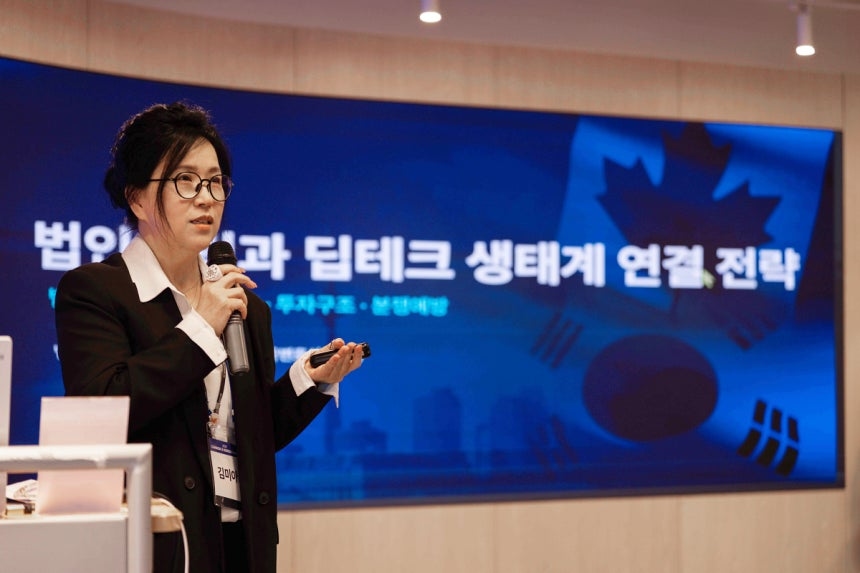
A recommendation has emerged that for domestic technology companies to settle into the North American market, they must meticulously design a technology and intellectual property (IP) protection structure from the early stage of entering Canada. The analysis is that Canada should be approached not as a mere place of incorporation but as a strategic hub connecting local research and development (R&D), investment attraction, and market entry.
Foreign Attorney Kim Mi-a (United States) presented a cross-border legal guide centered on this content as a presenter at the "2026 Canada X Korea Forum" held on the 21st at TIPS Town GSC in Seoul. This forum was arranged to build a Korea-Canada AI and mobility industry cooperation framework and to strengthen the linkage of the North American entry ecosystem.
Presenting in the "Insight: Why Canada?" session that day, Attorney Kim said, "Establishing a corporation in Canada is not merely an administrative procedure but the starting point of hub design connecting local R&D, proof-of-concept (PoC) projects, investment attraction, and market entry," adding, "Canada is a North American gateway with multi-nucleus AI clusters such as Toronto and Montreal," and "a clear strategy tailored to the purpose of entry must come first."
Attorney Kim cited the IP ownership issue as a practical risk that domestic companies frequently overlook in the process of overseas expansion. She explained, "Canada has a structure that determines the attribution of rights through contracts rather than uniform attribution by statute, with copyright law backing this up," noting, "It is difficult to conclude that the technology and IP of work created by in-house employees or outsourced developers automatically belong to the company."
She added, "The North American local legal system tends to strongly protect developers' rights, so a situation can arise in which core technology is not sufficiently secured."
As a solution, she advised that from the initial setup stage, clear IP-transfer and rights-waiver clauses should be reflected in employment and outsourcing contracts. She also explained that systematizing shareholder agreements is necessary to reduce equity dilution and management-control risk. As a practical point, she noted that consistently maintaining the definitions of terms across each contract document can reduce legal gaps when disputes arise.
This forum was co-hosted and co-organized by The Way Company, the FAMS 2026 Organizing Committee, and the World Korean Venture Network, among others.
Reporter Hwang Jung-won (garden@sidae.com)
[Read Full Article]\r\nForeign Attorney Kim Mi-a: "Success in Entering Canada Depends on Early Technology and IP Protection Design" (Go to Link)\rAll fields At a glance
1/0
Visit Consultation Booking
If you have legal concerns, consult a Litigation Involving Foreign Nationals specialist at a nearby office.

