


Press

2026-07-21
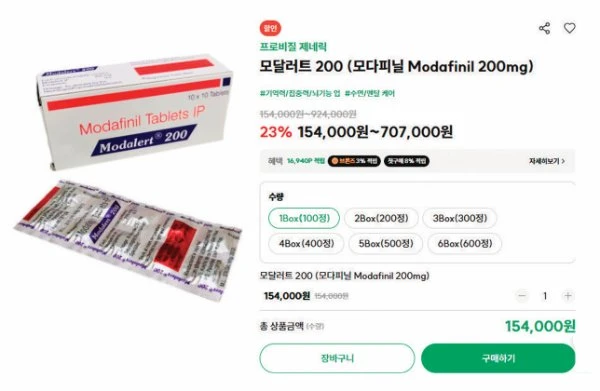
"I bought and took stimulants to raise my grades, only to suffer headaches and vomiting"—consumer harm is spreading
Mr. Lee, a third-year student at a high school in Seoul, obtained the stimulant "modafinil," known as a "study-well drug," a week before the June 4 mock exam. Out of a desire to boost concentration for the important test, he purchased it from an overseas direct-purchase medicine site without a doctor's prescription. After taking three 200 mg tablets a day for two days, Mr. Lee experienced side effects such as headaches, nausea, and vomiting over three days. Modafinil is a prescription drug mainly prescribed in Korea to patients with narcolepsy and attention deficit hyperactivity disorder (ADHD), and the recommended dose for the 200 mg product is one tablet a day. Mr. Lee said, "I learned about the overseas direct-purchase site on an online community and went in to find that anyone could buy the drug just by signing up as a member," adding, "The site called it a 'study-well drug,' so I bought it, and it was delivered by courier with no problem at all."
"Taking it recklessly without a prescription causes serious side effects"
A few years ago, among some parents and exam-takers in Seoul's Gangnam area, other ADHD-treatment prescription drugs "Penid" and "Concerta" became known as "study-well drugs" and were abused. Methylphenidate, the main ingredient of Penid and Concerta, is classified under current law as a narcotic (psychotropic substance). It must not be taken without a doctor's prescription. A pharmacist who responded to the interview said, "As prescriptions for Penid and Concerta became stricter, the demand for 'study-well drugs' seems to have shifted to modafinil, which can produce a similar stimulant effect," adding, "Modafinil, too, if taken recklessly, can cause serious side effects such as chronic headaches, vomiting, and sudden hyperactivity."
Is it really true that prescription drugs, which cause serious side effects when misused without a doctor's diagnosis and prescription, can be bought on the internet? When the reporter checked the site, it was selling not only various "copy drugs" (generic medicines: those produced by another manufacturer of an original drug whose patent has expired), said to be produced in India and elsewhere, but also original medicines said to be made by global pharmaceutical companies. The types of medicines ranged widely from prescription drugs to over-the-counter drugs. For example, Propecia-line drugs known as hair-loss treatments, Viagra taken for sexual-function enhancement, the schizophrenia treatment lurasidone, and even anticancer drugs were noticeable. Prices varied by drug but were generally about half to a third of the domestic pharmacy price.
The process of purchasing medicines on the site was simple. By entering an email address and just setting a password, one could sign up as a member without separate identity verification. The time it took from membership registration to purchasing a drug sold on the site was less than 5 minutes. The seller's explanation that "if caught in the customs clearance process, we will resend it" was also noticeable.
There seemed to be no way to verify whether the manufacturer and ingredient names marked on the medicines sold this way were true, or whether they were safe to take. Nevertheless, some domestic consumers use overseas direct-purchase medicine sites for reasons such as "you can buy needed drugs cheaply and in bulk" or "the doctor won't prescribe it." An official of the Ministry of Food and Drug Safety emphasized, "Overseas medicines brought in through abnormal channels are highly likely to be counterfeit or defective. Moreover, even if you suffer harm from taking them, it is difficult to receive protection under domestic law," adding, "Medicines must always be properly prescribed and taken under the guidance of a doctor and pharmacist."
In Korea, under Article 44, Paragraph 1 of the Pharmaceutical Affairs Act, in principle no one other than a pharmacist or herbal pharmacist may sell medicines. A violation is subject to imprisonment of up to 5 years or a fine of up to 50 million won. Article 50, Paragraph 1 of the same Act also contains a provision on "prohibition of sale outside a pharmacy." A violation may be subject to imprisonment of up to 3 years or a fine of up to 30 million won. In other words, selling overseas medicines online within Korea is illegal.
The reason overseas direct purchase of medicines thrives in the shadows is that there are blind spots in the law and system. Under the Pharmaceutical Affairs Act, unlicensed sale of medicines is strongly punished when caught, but since direct-purchase site servers are mostly overseas, it is difficult to identify the sellers. In addition, for buyers, except for certain ingredients, there is no legal basis to punish the improper purchase of medicines. Under current law, prescription drugs for which improper buyers can be punished are limited to steroids, injections of ephedrine ingredients, and medicines containing etomidate ingredients (Pharmaceutical Affairs Act, Article 47-4). Even this stops at a "fine for negligence of up to 1 million won." "This is because the Pharmaceutical Affairs Act was designed with a focus on regulating the supply chain—manufacturers, importers, and sellers of illegal medicines—rather than punishing improper buyers one by one," the legal community explains.
There is also no adequate way to block improper medicines at the customs clearance stage. Under current law, unless it is a clearly illegal drug such as a narcotic, medicines for "self-use" purposes can be brought in up to a maximum of 6 bottles (Customs Act, Article 94, and Enforcement Rule, Article 45, Paragraph 1, Item 1). Overseas sellers beyond the reach of domestic law enforcement, and domestic buyers who go unpunished even when improperly buying medicines, are cunningly exploiting the "self-use customs clearance" exception.
"Blocking site access and punishing buyers are needed"
On this, Attorney Lee Seo-hyung of the law firm Daeryun, a former pharmacist, pointed out, "Punishment of buyers should be expanded in stages, starting with high-risk medicines and repeated/bulk purchases." He also proposed, as measures to block sales: △blocking access to repeatedly caught sites; △blocking payments through credit card companies and payment gateways (PG); and △checking high-risk-ingredient drugs at customs clearance regardless of quantity. However, he added the following explanation, saying "there are limits to crackdowns alone":
"There are various reasons consumers seek illegal medicine direct-purchase sites. From the consumer's standpoint, they regard as advantages being able to skip the hospital visit and prescription process, which feels cumbersome, and to obtain medicines at a relatively low price. On top of this, there is also the incentive that, by obtaining treatments through direct-purchase sites, one can avoid revealing sensitive conditions such as hair loss or erectile dysfunction to others. Therefore, there is a need to make legitimate prescription channels convenient—by institutionalizing telemedicine and simplifying the procedure for re-prescribing chronic-disease medicines."
Reporter Park Seung-hyun parksenal@donga.com
[View Full Article]
In Just 5 Minutes, Buying Everything Up to Anticancer Drugs Without a Doctor's Prescription... Overseas Direct-Purchase Sites Illegally Selling Medicines Are Rampant (Go to link)
All fields At a glance
1/0
Visit Consultation Booking
If you have legal concerns, consult a Litigation Involving Foreign Nationals specialist at a nearby office.

