


Press

2026-08-06
40℃ New Normal ②]
The mandatory rest at 33℃ is a pie in the sky
A safety net must be provided for delivery workers and others
[Editor's note] The heatwave is changing society. From schools and the military, sports events, industrial sites and the labor market, to welfare policy and urban infrastructure, systems designed around the climate of the past are showing their limits. The era of enduring the heat is over. It is now time to redesign the nation and its social systems on the premise of heatwaves. [Sidae] examined the sweltering field.
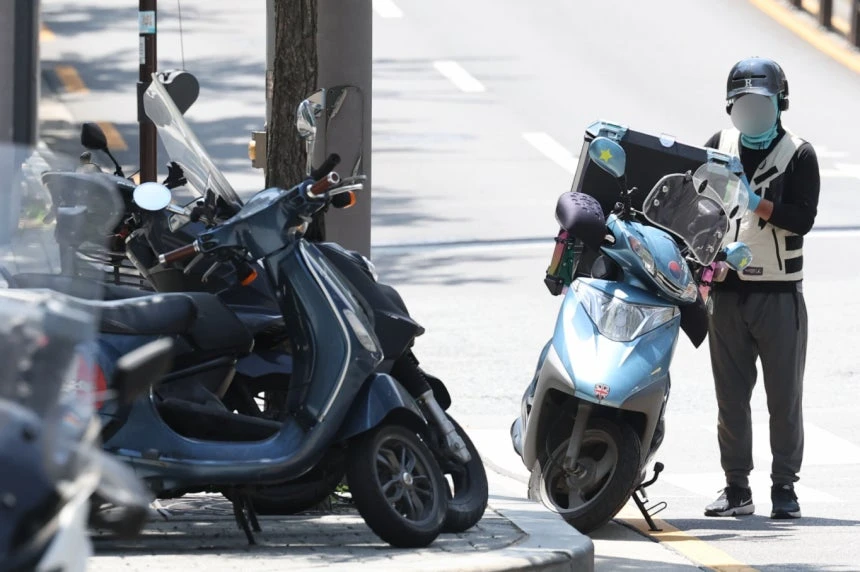
On the 4th, a delivery rider in his 50s working in Yangju, Gyeonggi Province, showed symptoms presumed to be heat exhaustion and was transported to a hospital. Although the heatwave warning continued, he could not stop working, because of a structure in which income is cut off the moment he rests.
The heatwave has become a disaster the state must manage, but the way the risk is borne is not the same for everyone. Companies can disperse climate risk through insurance, flexible work, and work adjustments, but delivery riders, courier drivers, and construction day laborers lose their income the moment they stop working. Even though the heatwave has become a national disaster, many workers are being forced to choose between danger and their livelihoods, critics point out.
At the Cabinet meeting on the 4th, President Lee Jae-myung also defined the heatwave as a "state disaster situation" and ordered a review of whether the right to stop work is actually functioning. He also emphasized the need to expand heatwave shelters and redesign the disaster response system.
According to the 'Study on the Scale of Platform Workers' released by the Ministry of Employment and Labor this May, the number of special-type/platform workers and freelancers is estimated at about 2.1 million. Among them, delivery riders, courier drivers, and golf course caddies are cited as representative occupations that find it virtually difficult to stop working even in heatwaves.
From this year, the government has mandated that workers at worksites with a perceived temperature of 33℃ or higher be guaranteed at least 20 minutes of rest within every 2 hours. At a perceived temperature of 38℃ or higher, it also recommends suspending outdoor work except for emergency measures. However, many special-type/platform workers fall outside the direct scope of this system's protection, because their income structure, centered on per-case fees and daily wages, means their income disappears the moment they rest.
The heatwave is a disaster…but rest means '0 won' in income
Experts point out that, now that the heatwave has been recognized as a recurring climate disaster, discussion must move beyond workplace safety to an income safety net. Kim Sung-hee, head of the Institute for Industrial and Labor Policy, said, "The heatwave is an area where natural disaster and social disaster overlap, but the protection system for it is still empty," adding, "Since there clearly are workers suffering harm from the heatwave, discussion on establishing a social safety net is necessary."
However, designing the system is not a simple matter. Director Kim explained, "Creating objective standards for how far and by what criteria to support income losses caused by heatwaves is not an easy task," and "Since there are many difficult problems to solve, considerable social discussion and consensus are needed."
He suggested, "For now, indirect support such as expanding shelters for mobile workers and providing cooling facilities should be strengthened, and in the long term, the government and the National Assembly should begin discussions on building a labor safety net suited to the heatwave era."
The legal community also points out the limits of the current system. Attorney Cho Ik-cheon of Daeryun Law Firm said, "The scope of industrial accident insurance for service providers has been expanded, but heat-related illness has the characteristic of requiring proof of a substantial causal relationship with the work, so there are considerable difficulties in actually being recognized as an industrial accident."
He added, "Because the degree of heat exposure, the intensity of the work, and pre-existing conditions must all be comprehensively considered, there is an aspect in which the current legal system alone is insufficient to fully protect platform workers," and "Recently, some court rulings recognizing the worker status of certain delivery riders have emerged, but it will take time until an institutional mechanism to protect the field as a whole is prepared."
Companies disperse risk…individuals face income gaps
Private companies are also raising their level of response. CJ Logistics operates a 'right to stop work' allowing delivery drivers to autonomously halt work in disaster situations such as heatwaves and heavy rain, along with an 'exemption right' regarding delivery delays. Delivery platforms are also stepping up hot-season safety management, such as expanding shelters and providing bottled water and cooling supplies.
However, such measures are closer to company-by-company voluntary management. Companies can disperse climate risk to a certain extent through insurance, work adjustments, and exemption systems, but individual workers are placed in a structure in which income is cut off the moment they stop working. The scope and level of support also differ by company, so critics point out there are limits to viewing this as a social safety net protecting all special-type/platform workers.
Experts emphasize that, now that the heatwave has been recognized as a recurring climate disaster, discussion on a system protecting individual workers is necessary. Just as the government and companies reduced infection risk by introducing remote work and staggered commuting during the spread of COVID-19, they say a response system suited to the characteristics of each occupation must be prepared for the heatwave as well. They explain that an adaptation strategy is needed in which office workers expand remote and flexible work, and mobile workers are guaranteed sufficient rest and shelters.
One platform industry official said, "Companies prepare for climate risk through insurance and various risk management systems, but for a worker, income becomes '0 won' the moment they rest for a day due to the heatwave," and "Just as various social safety nets functioned during wildfires, floods, and COVID-19, it is time to begin discussing in earnest a labor safety net suited to the heatwave era."
He added, "We need to review a variety of alternatives, from direct support such as a heatwave shutdown allowance or climate unemployment benefit to flexible work methods like expanding remote work during heatwaves," and "Since there are limits to private efforts alone, the government and the National Assembly must step up to prepare effective systems."
The heatwave is no longer a seasonal inconvenience but a disaster the state must manage. While companies disperse climate risk through various systems and insurance, many workers still bear the danger of the heatwave and income loss alone. Experts agree that the task of the heatwave era is not merely to increase shelters, but to build a labor safety net that guarantees both the right to stop work in the face of disaster and one's livelihood.
Reporter Hwang Jung-won (garden@sidae.com)
[Read the full article]
No Rest Even in Heatwaves…The Dangerous Summer of 2.1 Million Special-Type Workers (Go to link)
All fields At a glance
1/0
Visit Consultation Booking
If you have legal concerns, consult a Litigation Involving Foreign Nationals specialist at a nearby office.

